Syrian immigrants fear for their non-Muslim relatives facing sectarian violence
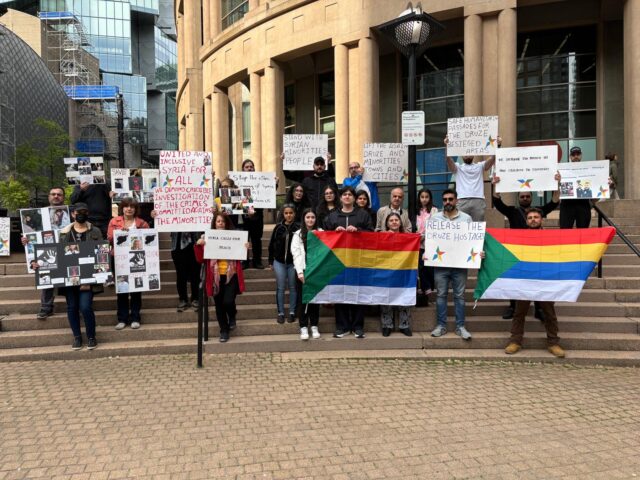

Every time Sana Barouki’s phone rings, she answers with a pounding heart. It has been the rhythm of the 50-year-old’s life in Vancouver since Abu Mohammad al-Julani — now interim president Ahmed al-Sharaa — toppled Bashar al-Assad in 2024.
Barouki had felt a spark of hope when Assad, who had ruled Syria for over half a century along with his father Hafiz, was removed from power. That fleeting relief gave way to fear; Al-Sharaa, a former militant with ties to al-Qaeda and the founder of Hay’at Tahrir al-Sham, seized control, and life for religious minorities became precarious again.
Barouki’s Druze community, along with Alawites, Christians and others, faced renewed hardships and uncertainty.
“During the July attacks, I went through 48 hours of pure agony as my brother was caught in the massacre of Druze that was going on in his hometown,” said Barouki, a social worker with the Vancouver School Board. “Druze majority cities are now under siege, with no water, food, medicines or electricity.”
According to the 2021 Canadian Census, there are 5,990 Druze in Canada. Some emigrated from Syria and others from Lebanon and Israel. Alberta is home to the largest share of this population.
Barouki was fortunate to come to Canada as a skilled immigrant in 2006, five years before protests against al-Assad began. Civil war in Syria erupted in March 2011, and a report published by The Guardian stated that 11.5 per cent of the population was killed or injured, with 12 million people displaced internally or immigrating to neighbouring and western countries.
On Dec. 8, 2024, after 13 years of civil wars, Assad’s reign ended and there was joy among Syrians and their diasporas. But the change also created fear for the country’s religious minorities, and people who follow the Druze religion are one of them. The Druze are a Middle Eastern religious community that originated from Ismaili Shiʿism in the 11th century, with roughly one million members. About 700,000 live in Syria, mainly in the south.
In Vancouver, Barouki organizes protests near the downtown library and art gallery and sets up initiatives to support her community in Syria, which has long endured shortages of food, medicine, electricity and clean water.
“We send money to someone in Syria to buy food and hospital supplies,” said Barouki, who brings her children to meet with other Druze families in the community every week. “We also send money to my city through the Red Cross”
Barouki said her family is fearful of the future, and she shares their despair. “The fear of what might happen next looms over us, affecting our mental well-being and daily lives.”
Syria’s Alawites have also been targeted. Between late February and early March 2025, waves of attacks struck towns and villages with Alawite majorities.
By June 2025, Reuters reported that roughly 1,200 Alawites had been killed across 35 distinct sites during this wave of sectarian violence.
Sarah Abas, a Chilliwack-based Alawite and co-founder of the Western Syria Alliance, said she has lost several relatives including her 23-year-old cousin, Ahmed Khaddour, who was killed for his religion by al-Sharaa’s forces.
“He was brutally beaten and tortured with rifle butts for refusing to imitate animal sounds, resulting in broken ribs and ultimately, his death,” she said.
The Alawites are a Middle Eastern religious minority, often seen as a branch of Shia Islam with distinctive beliefs and practices. They are primarily concentrated in Syria, with about 2.1 million followers.
Abas moved to Canada about 20 years ago, but remains in close contact with her family, especially during crises.
“Their reality is one of systematic starvation, enforced impoverishment, deliberate economic suffocation, violations of religious sanctities, and the bombing and desecration of sacred sites,” Abas said.
“Their situation is catastrophic. They live under total suppression of freedoms, speech, belief, movement, dignity and livelihood.”
Abas’s fear is that her people are now facing a slow-moving genocide through killing, forced displacement, starvation, economic destruction and permanent terror.
Under al-Sharaa’s regime, Christians — like other minorities and civilians — have also faced waves of violence and instability. Hassan Nijm, a Canadian Syrian and member of the Christian community, is hoping for change but remains deeply concerned for his family’s safety and rights under Syria’s new transitional government.
Canadian census data shows 39,115 Canadians of Syrian origin identify as Christian.
“My family lives in a remote village and is still safe, but they are worried about their future under al-Sharaa. They do not know what would happen to them,” Nijm said.
Syrian religious minorities in Canada are unable to return home to support their families and they are limited in what they can do from afar. Njim wants the international community, especially the U.S., Canada and other western nations, to pressure the transitional government to implement essential reforms.
“The aim is to encourage this transitional government to begin a genuine, extensive national dialogue leading to a democratic, civil and secular constitution, followed by the formation of a government representing all segments of Syrian society,” he said.
Abas called on Canada to condemn the targeted violence against Syrian minorities and to establish an emergency humanitarian pathway similar to the Canada-Ukraine program.
The post Syrian immigrants fear for their non-Muslim relatives facing sectarian violence appeared first on New Canadian Media.
Similar Posts