TAG Publishes New Security Quarterly: Operational Technology Gets Its Moment
TAG Infosphere’s Q2 Security Quarterly Available for Free Download
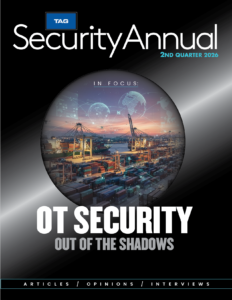
New York City, May 27, 2026—Tag Infosphere has released its new security quarterly focusing on Operational technology (OT). OT is the workhorse behind the scenes. It’s the electric grid, sewage substations, oil pipelines. It’s the infrastructure that keeps countries going. It’s also targeted frequently by nation-states and cyber criminals of all kinds. The latest issue of TAG’s I Security Quarterly features seven articles that demonstrate the diversity of challenges OT environments have faced and are now facing—including today in Iran.
“OT Security Out of the Shadows” explores some of the early security breaches that were foundational in this field, like the Stuxnet attack the United States and Israel launched against the centrifuges Iran was using more than 25 years ago to enrich uranium. As TAG CEO Edward Amoroso wrote, it was “the first publicly known cyberattack to cause deliberate, physical destruction of targeted industrial equipment.”
The current war in Iran is bringing those memories back, and Amoroso reviewed what made that attack so startling, and why nothing of that caliber has been repeated since. He added that he thinks that’s likely to change: “Stuxnet not only can happen again but probably will soon.”
An article by TAG’s analysts delves into the current conflict in Iran, which of course features the same three antagonists, and Iran’s critical infrastructure is once again being targeted. This article attempts to determine if the U.S. and Iran are coordinating their respective kinetic and cyber operations; and if so, in what way? And what can we conclude about this growing area of modern warfare?
Another article is an interview with Joe Weiss, an OT pioneer whose background is in engineering. He talked about another early event that proved how damaging these attacks can be. In 2007, the Idaho National Laboratory conducted an experiment to see if it could destroy a generator remotely through a cyberattack. The lab succeeded, he said, “by remotely reclosing electrical relays out of phase with the grid.” The result was equipment damage so severe it was “beyond repair.” And no malware was involved.
A big problem Weiss sees is that even though information technology (IT) has been introduced into many OT environments, the people who work in OT and IT are diverging, not converging. “The people in OT security want to use IT security approaches to try to secure these control system devices. And in many instances, they have caused as much damage as the hackers,” he said. It’s because they come from different worlds, he added. University computer science departments don’t offer students even an introduction to engineering, and engineering departments don’t introduce their students to computer science or cybersecurity.
A third article is a first-person account by Matthew Wainwright, who was hired to manage the introduction of IT technology into OT infrastructure—specifically, the conversion of 16 substations that keep the sewage off of a New England community’s beaches. He came in with a background in IT, but he was careful not to convey the impression that he thought he was an OT expert.
“IT and OT have converged,” Wainwright writes, “but not always successfully. The result can be a mess. I think people thought they could turn OT into IT, and you can’t do that. It’s never going to work. And honestly, it can cost people’s lives.”
That wasn’t his approach, Wainwright continued. He knew he had a lot to learn, but he was eager to work with the OT team he was managing. He also consulted with people who knew a lot about the world he was joining, including Joe Weiss. He described the attitude that made it work: “I don’t really know about OT per se, but I can definitely do this. I can definitely do it with the right team.”
Free Download: The TAG Security Quarterly “OT Security Out of the Shadows”
For media inquiries, please contact: Lester Goodman, Director of Content, TAG Infosphere lgoodman@tag-cyber.com; 914-588-1369
About TAG:
TAG utilizes an AI-powered SaaS platform to deliver cutting-edge insights on cybersecurity, artificial intelligence, and climate science. The company’s unique approach combines technology and expertise to empower organizations with the knowledge needed to navigate these complex landscapes. We provide on-demand recommendations to commercial solution providers and Fortune 500 enterprises.
Similar Posts

Lavish Event Rentals Expands to Orlando, Elevating Luxury...