How “Big Canada” went bust
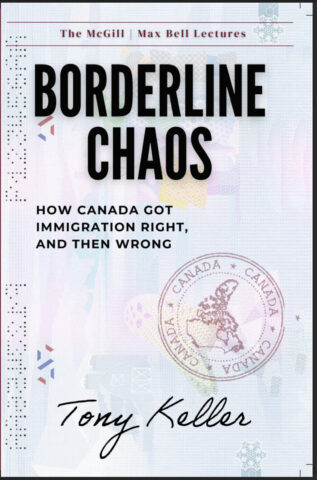

Review: Borderline Chaos, by Tony Keller (Sutherland House, 2025)
The federal budget presented to Parliament Nov. 4 included a section on annual immigration targets, a rather unusual addition given the document’s essential economic focus. However, given how badly immigration has gone off the rails, this addition perhaps helped relieve some of the public anguish over too many newcomers arriving too quickly, setting off a chain reaction across the country.
There is no demographer or economist who argues Canada’s immigration system currently lives up to the promise of a “fair and meritocratic” system that meets our national goals while still enabling immigrants to thrive in their new country. This sombre outlook has also been reflected in plunging confidence among Canadians.
Tony Keller – a respected business columnist for the Globe and Mail – makes a compelling argument in 95 short pages that the now-departed government of former prime minister Justin Trudeau created such a mess that it will take years to undo the damage. It threw caution to the wind, heeding “self-dealing” advice from the business lobby.
“Canada conducted a decade-long [Big Canada] experiment. The experiment’s principal investigator was the Trudeau government, assisted and enabled by the provinces, the business community, and the higher education sector. They were opposed by essentially nobody.”

In a scathing indictment of the Trudeau era’s “lost decade,” Keller says, “Canada’s plutocratic lions and progressive lambs had laid down in agreement, first for higher immigration and then for something close to an open-borders policy” that led to an onrush of international students, temporary workers and refugees arriving through wide open doors.
The author lays much of the blame for the Big Canada idea to a lobby group called the Century Initiative that burst onto the national scene in 2016, shortly after Trudeau came to power. The Century Initiative was the brainchild of Dominic Barton, the then head of global consulting firm McKinsey, who would go on to be Canada’s ambassador to China.
This lobby group had a rather simplistic recipe to make Canada an economic powerhouse: Grow our population to 100 million by the year 2100 through higher immigration. Century’s clout in Ottawa grew exponentially when Barton was also nominated chair of an advisory council on economic growth. In the author’s opinion, this council skewed heavily in favour of business, with no representation from labour, resembling “a lunch table at the World Economic Forum,” a much-derided club of politicians and billionaires who convene in the Swiss Alps for an annual soirée.
In a nutshell, the author finds, Canada’s business elites, the Trudeau government and mandarins in the immigration department recklessly pursued quantity over quality when it came to new immigrants in the years since 2016, reaching a climax in 2023 when the country received an astounding 1.3 million newcomers.
Keller traces much of this flood to the Century Initiative’s recipe for economic growth: Grow the population through immigration, lower Canada’s median age and grow the economic pie without considering that there would be many more people to feed, more homes to build, more family doctors needed as well as support services for newcomers in smaller communities. This policy prescription found its ultimate validation in the budget of 2023, when the Trudeau government conflated a post-pandemic population surge with a fast economic recovery.
The government boasted Canada had the fastest population growth in the G7 – a grouping of the world’s biggest economies – and asserted that “immigration is a significant driver of economic growth and helps to build a stronger economy for everyone.”
The Big Canada idea added cohorts of international students who were supposedly arriving for higher education enrolled at dubious institutions that a future immigration minister called “puppy mills.” They were, in fact, attracted by the implicit prospect of settling permanently in Canada.
The same idea also saw large numbers of temporary foreign workers arriving without adequate labour rights protections, sometimes housed in miserable conditions, with no guarantee that they would leave at the end of their work visas. All of this, “to do work Canadians allegedly didn’t want, at wages Canadians wouldn’t accept.”
While Borderline Chaos rightly identifies the many ways in which immigration policy was derailed by a government intent on giving in to business lobbies, it offers no explanation about why there was no course correction even after public opinion began plummeting.
The fallout of Big Canada’s misplaced enthusiasm is apparent in overcrowded hospital emergency departments, skyrocketing rents, unaffordable housing, stagnant wages at the lower end of the economic ladder and high unemployment among fresh university graduates. These young people are most affected by unbridled foreign labour. We now also have a new problem just like the Americans: A large number of migrants without status.
One hopes Canada’s much-vaunted consensus on immigration can be restored in short order, regaining public trust, even as the government closes side doors and irregular immigration streams. It is high time we return to Canada’s contribution to the world: The reliable points system that determines who gets to come to Canada using a combination of age, education, language skills and employability.
One of the other lessons I took away from the book: Canada needs to foster a conversation on immigration that is not dominated by those who have a vested interest in keeping wages low. Keller’s Borderline Chaos tells us we need a civic discourse that places the national purpose above all other private interests.
The post How “Big Canada” went bust appeared first on New Canadian Media.
Similar Posts