Sudanese Canadians waiting years to bring family from war-torn home country

Sumaya was just one of dozens of people waiting in western Sudan for a simple notification from Canada’s immigration officials welcoming her to Canada. She died in Darfur in western Sudan, before her paperwork was processed — just one piece of paper and maybe a safe flight away.
While she was waiting for a message from Canadian immigration, the war caught her and Sumaya became one of a growing number of Sudanese victims who have died with an “incomplete” file in Canada’s immigration queue. The war between the Sudanese Armed Forces (SAF) and the Rapid Support Forces (RSF) began in April 2023 and has turned into a brutal humanitarian catastrophe. Since then, millions have been caught in the crossfire of ethnic violence and starvation, with no end in sight.
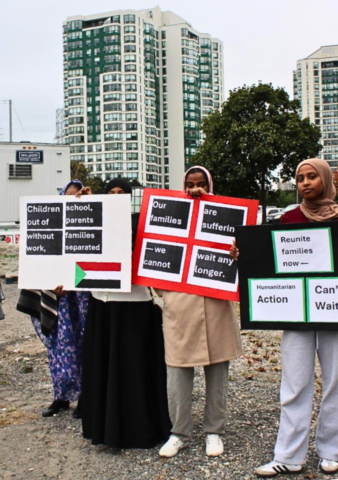
In 2024, Ottawa launched the Sudan family reunification pathway, and the government announced it would be a lifeline for the Sudanese-Canadian community. But what was supposed to be an emergency way out of the country has led to bureaucratic delays and wait times that could last for years.
As of January 2026, the war in Sudan has surpassed 1,000 days of relentless violence, with conservative estimates placing the death toll at more than 150,000 and creating the world’s largest displacement crisis according to the World Health Organization.
Based on calculations by federal MP Jenny Kwan, people will wait 13 years for their paperwork to be approved.
“It is based on the number of applications in the backlog for the three categories and current processing rate based on the levels plan under ‘Other’ category,” said Kwan, the NDP’s immigration critic.
“A ِ13-year wait is a denial of safety,” Kwan told New Canadian Media. “Family reunification is supposed to be a humanitarian pathway, not a bureaucratic lottery that forces people to wait through war, displacement and famine.”
Official targets explain the gap. Kwan said the government’s immigration levels plan intentionally caps arrivals, leaving thousands of approved families in limbo.
“Canada’s response to Ukraine demonstrated that our immigration system can be fast, flexible, uncapped and compassionate when the government chooses to make it so. Sudanese families are asking a simple and fair question: Why are those same tools not being used for them?”
Abier Mustafa, a Toronto-based Canadian immigration consultant who has handled these files for months, said that the current pace is a systemic failure.
According to data from Immigration, Refugees and Citizenship Canada, 2,345 people from Sudan have arrived in the country despite thousands of applicants. This gap highlights the slow pace of processing, as thousands of other applicants remain in limbo while the conflict intensifies.
“Nearly three years since the conflict began, only about 25 per cent of applicants have arrived in Canada,” Mustafa said. “This is not just a crowded queue; it is a failure to prioritize a life-saving humanitarian program, leaving thousands of families in active danger while their files remain untouched.”
The tragedy extends beyond bureaucratic waiting lists to a more harrowing reality; the abandonment of Canadian citizens by birth. Mustafa said children who were born in Canada are stranded in war zones because their Canadian-born fathers have died and their non-Canadian mothers are unable to accompany their children to safety. “I have handled cases involving Canadian children who remain stranded because their non-Canadian mothers have no immigration pathway,” Mustafa said.
Scarborough resident Sarah Mahmoud has been waiting since February 2024 for her parents and her sister’s family to be approved to immigrate. She describes a life of prolonged uncertainty.
“I have had to take on an additional part-time job to cover their basic living expenses, placing long-term stress on my household,” Mahmoud said.
Mustafa said sponsors are required to deposit large sums into designated accounts that have remained frozen for nearly three years while families wait to be reunited. This financial burden has left families in a state of suspended animation, unable to access their savings or secure the safety of their loved ones. “There has been no transparency regarding when applications will be processed,” she said.
The danger is not limited to those remaining within Sudan’s borders. Even those who crossed the border have not found peace; they are now trapped in a queue between the trauma they left behind and a future that hasn’t arrived.
Edmonton resident Razan Nour said her family applied to sponsor her uncle and grandfather, hoping for a swift reunion. But while the application was pending, her uncle was kidnapped by the Rapid Support Forces and held for four weeks.
Although he managed to escape, the continued delays and fear for his safety convinced the family in Canada to help him illegally relocate to Egypt. Nour said the toll of the journey and the trauma proved too great and her uncle died in Egypt.
Her 87-year-old grandfather, whose age deemed him exempt from biometrics, was still waiting for his application to be processed when he died suddenly from heat exhaustion. Nour believes that delayed processing contributed to the death of her grandfather.
Liberal MP Salma Zahid acknowledged the severity of the crisis in a statement to NCM.
“For families fleeing the violence in Sudan, reunification with loved ones in Canada is a lifeline,” Zahid said. “Canada’s family reunification pathways must remain accessible, responsive and compassionate — especially for those escaping active conflict zones. In times of crisis, Canada must act with urgency to keep families together and uphold our humanitarian values.”
Immigration, Refugees and Citizenship Canada spokesperson Matthew Krupovich said in a statement that the program is bound by annual limits. While advocates calculate a 13-year backlog, Krupovich said that when demand for a specific pathway exceeds the available spots for a given year, “processing times will be longer.”
He said that IRCC is trying to be “fair, orderly and sustainable” while facing an increasing number of complex applications. Despite the community’s calls for a more rapid, uncapped response similar to other crises, Krupovich maintained that each humanitarian commitment has its own parameters and that “applicants are not ranked against other nationalities or programs.”
Krupovich said the application cap was increased to more than 5,000, enabling Canada to accept about 10,000 people under the family reunification pathway. Between April 2023 and November 30, 2025, more than 15,830 people from Sudan have been approved for permanent residence, but only 2,345 people have actually arrived in Canada under this pathway, he said.
Elbagir Abdulkarim, whose mother died in March 2025, said there is a “failure of urgency” to get people out of Sudan. For those whose loved ones died while waiting, the slow processing pace has turned a hopeful program into a painful loss.
“My mother died waiting. She dreamed of her grandchildren’s embrace in a place of peace,” Abdulkarim said. He compared the government’s response to Sudan to its immigration program for Ukraine. This disparity has led immigration experts and community leaders to question the equity of Canada’s humanitarian response.
“Why does the geography of a crisis seem to dictate the urgency of Canada’s heart?”
The post Sudanese Canadians waiting years to bring family from war-torn home country appeared first on New Canadian Media.
Similar Posts